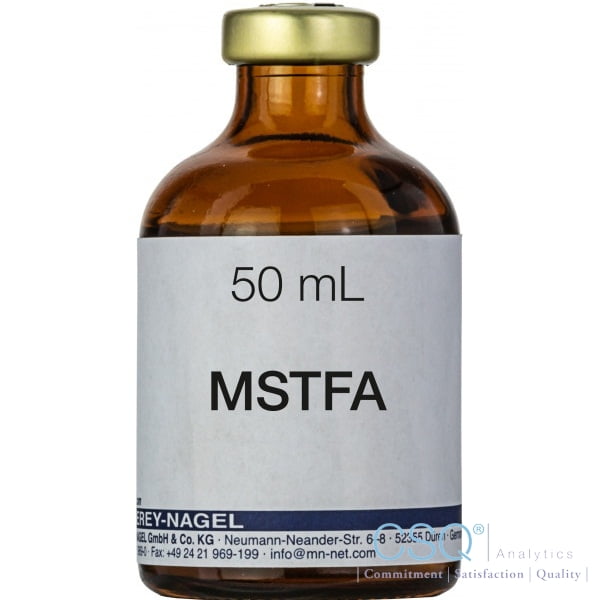
Derivatization reagents for GC, silylation, MSTFA

The most volatile trimethylsilyl amide available. MSTFA is a very strong TMS donor which does not cause any noticeable FID fouling even after long-time measuring series. The already good solution characteristics can be improved by addition of submolar quantities of protic solvents (e.g., TFA for extremely polar compounds such as hydrochlorides) or pyridine (e.g., for carbohydrates). Advantages of MSTFA are complete reaction with high reaction rates, even without a catalyst (1–2 % TMCS or TSIM) and the by-product of the reaction (N-methyltrifluoroacetamide) features high volatility and short retention time. These products contain harmful substances which must be specially labeled as hazardous.

Clear

Technical Data

Selling unit 1×10 mL, 1×100 mL, 5×10 mL, 6×50 mL, 6×100 mL, 12×100 mL, 20×1 mL
Method Gas chromatography (GC), derivatization
Composition N-methyl-N-trimethylsilyl-trifluoroacetamide (MSTFA)
Derivatization type Silylation
Recommended application(s) Alcohols, Amine hydrochlorides, Amines, Amino acids, Carboxylic acids, Derivatization, Hydroxy acids, Ketocarboxylic acids, Mercaptans and similar compounds with active hydrogen atoms, Often used in doping control and forensic applications, Polyalcohols, Sugars
Storage temperature 2–8 °C / 36–46 °F
Hazardous material Yes


Safety Information according to CLP
WARNING
H226 Flammable liquid and vapour.H302 Harmful if swallowed.H315 Causes skin irritation.H319 Causes serious eye irritation.

Download

Download link
Download Catalog Chromatography (English)

Download Instructions (brochure) GC derivatization reagents